Showing posts with label Israeli Politics. Show all posts

Thursday, June 6, 2013

A reminder why we need to look after ourselves

Proponents of the "Two State Solution" often poo-poo Israel's security concerns claiming that once we have peace, security won't be an issue (after all, we have "Peace"), and in any case, we could have a UN controlled peace-keeping force keeping the peace, in the unlikely event that anything would go wrong.

Given the instability of all the states surrounding Israel (with the possible exception of Jordan), the first argument is silly - just because we signed a Peace Pact with the current Palestinian Administration, there is no guarantee that they would keep it, and it is unlikely that they would stay in power (see Gaza where Hamas ousted the Palestinian Authority within months of Israeli disengagement).

Ah-ha - peace proponents say, that's why would get security guarantees from a third party like the UN or the US. These proponents have obviously never  heard of the 1956, 1967, or 1973 wars when UN peace keepers left as soon as there was a serious threat of war.
"But surely that is ancient history" I hear you say; things have changed now ... except that today Austria announced that they are removing their peacekeepers from the Golan Heights - after all, it could get dangerous there. I guess relying on peace keepers in the region only makes sense if we knew that there would never be the threat of was (in which case, why do we need the peace keepers?).


Bottom line is, if we ever sign a peace agreement, it must include the ability for Israel to defend itself without relying on the partner signing the agreement or a third party.

Am I against the concept of a Palestinian State? Not at all, the concept sounds like a fair just solution. I'm against the reality of a Palestinian State.
Right now, I cannot conceive of an independent Palestinian State that would not lead to missiles being fired at my home.

My vision of peace does not include missiles being fired at me and my children. If not wanting missiles fired at my home makes me ant-peace, so be it.
If someone can suggest a Peace Plan that would not lead to missiles being fired at my home (or the homes of other Israelis), I'm in favour. I just haven't heard of such a proposal yet.

And if you're wondering what I think we should be doing to encourage peace, I am a big believer in interaction between Jews and Arabs; the more that we interact with each other on a personal level, the more likely that our children will be able to live together in harmony. (I wrote about it a few years ago).
The concept of a Palestinian State is exactly the opposite - it discourages personal interaction between Israelis and Palestinians, in fact it often makes it illegal (it is currently against the law for Israelis to enter many Palestinian territories).

Given that right now, there is no serious realistic peace plan on the table, and no serious partner on the other side, I guess Secretary of State Kerry got it right -
People in Israel aren’t waking up every day and wondering if tomorrow there will be peace because there is a sense of security and a sense of accomplishment and of prosperity.”

Makes good sense to me. Lets hope that our sense of security, accomplishment, and prosperity continue to increase - and people pushing for a diplomatic process that directly puts my life in danger will continue to be ignored.

Thursday, January 28, 2010

Did I just agree with Larry?

About a year ago I outlined my idea of how we can move towards peace in this tiny land.

Basically my theory is that high-level peace talks only lead to distrust and friction as our leaders meet as adversaries across a negotiating table. Everyone is pushing for a better deal and in the process demonizing the “other”.

In additional, borders, fences, violence, and mistrust make it increasingly difficult for Jews and Arabs to interact on a personal level.

I believe that the best way forward is to leave the “political process” and instead invest in educational, medical, and social opportunities for Jews and Arabs to interact.

If a generation grows up that don’t think of the “other” as “the enemy” possibly they will be able to make peace (I’m talking about at least 20 years from now, not “Peace Now”). The exact details of the peace plan, whether a Palestinian State (with open borders and a Jewish minority), or a semi-autonomous state, or a bi-national state, or any other solution can only de discussed once we have learned to live together.

I’m not sure whether I should be glad or frustrated that today there was a column in the (new look) Jerusalem Post which agrees with me that we need to find ways for Jews and Arabs to interact.

Frustrated because the author, fellow Modi’in resident Larry Derfner is well known for his incoherent articles. Although presented as a left-wing columnist, he is not a good spokesman for the left as his columns normally make so sense other than whatever the problem, Israel (or “The Settlers”) are to blame.

I hope that the fact that in this instance I seem to be agreeing with him does not dis-prove the logic in my idea.

Thursday, August 27, 2009

Don’t let the facts get in the way

I was just forwarded a link to a site by a “young New Zealander” where he tries to give perspective to global events.

I haven’t gone through every page on his site, but his article on the history of the “Israeli-Palestinian Conflict” seems poorly researched and written. His terminology and use of language looks like it comes directly from a Palestinian propaganda style book and he manages to make significant historical errors in almost every single paragraph, quite an accomplishment.

In the interest of fairness, I though I’d point out some of his most glaring errors.

Conflicting British Promises

During WWI, Britain supported independence from Turkish rule for the mainly Arab population of Palestine, who had lived in the area for thousands of years. To gain Jewish favour, Britain also supported the establishment of a Jewish homeland in Palestine.

False: In the 1800s the area was vary sparsely populated. Although there was a small Arab community going back to the 7th Century (hardly “thousands of years”), the vast majority of the Arab population came in search of better economic opportunities at the end of the 1800s or early 20th Century.
The only population that had been in the land for "thousands of years" was the relatively small Jewish population that can trace itself back to Biblical Times.

Awarded Palestine at the end of WWI, Britain saw how conflicting its promises were: Jews began moving to Palestine, clashing with locals who believed in their own dreams of independence.

The Holocaust

After WWII, the world saw the full horror of the Holocaust and became sympathetic to the establishment of a Jewish homeland. Sadly it was the Palestinians who had to suffer for Europe’s guilt.

False: Firstly it wasn’t “European guilt”, The Arab community (particularly Haj Amin al-Husseini, Mufti of Jerusalem who was a guest of Hitler in Berlin for the duration of the war) supported the Nazis and were also partially responsible for the horrors of the Holocaust.
Secondly, the State of Israel was one of many states created after WWII with the breakup of the British Empire. The movement to create an Independent Jewish country pre-dates any attempts to create an Arab State in the area or the Holocaust and was not a result the Holocaust.

Britain’s control of Palestine became a burden. Violence increased between Jews and Palestinians. Jewish terrorist groups attacked the British – most infamously blowing up their headquarters at the King David Hotel.

False: It is true that "Violence increased between Jews and Arabs", but the violence was almost all in one direction - Arabs attacking Jews. There were Jewish military groups (Hagana, Palmach, Lechi), but they were almost exclusively for self defence. The Lechi/Stern Gang which did take the offensive on occasion could not be defined as "Terrorism" as they attacked only British Military establishments (The King David Hotel housed British HQ). Also interesting that the author failed to mention the Arab riots of 1929 and 1936-39 which were terrorist attacks against (mainly Jewish) civilians.

In 1947 Britain asked the United Nations (UN) to make a decision on the future of Palestine. The UN voted to split Palestine in half – into separate Jewish and Arab states.

Birth of Israel

On May 14 1948, Jewish leaders announced the birth of Israel. The next day surrounding Arab countries declared war on them. After a year of fighting, Israel defeated the Arab-alliance and secured its survival.

Palestinians who lived within Israel’s borders were forced to leave. If they refused, they were beaten or simply murdered. Over 750,000 Palestinians fled their homes. Today they and their descendents still live in terrible conditions in refugee camps.

False: The Palestinians were not "Forced to Leave", many Arabs stayed and are now full equal citizens of the State of Israel. There were very few (if any) examples of Arabs who refused to leave being "beaten", certainly not murdered, in fact many Jewish leaders begged the Arabs not to leave and explicitly offered them equal rights and a called for peace in the declaration of independence.
Many Arabs did flee, but this was mainly in response to fear generated by Arab propaganda which tried to demonize the Jews by exaggerating, or creating false accounts of Jewish attacks against Arabs.

Six-Day War and Occupation

In 1967, Israel initiated the Six-Day War with Egypt, Jordan and Syria. By its end, Israel had taken control of the Gaza Strip and the West Bank – the only land the Palestinians had left since Israel’s creation.

False on 2 accounts: Firstly the Israelis did not initiate the 6 Day war, it began when Egypt violated the cease-fire agreement and positioned tanks on the border and broadcast that they intended to destroy the State of Israel.
Secondly the Gaza Strip and West Bank were not "the only land the Palestinians had left”, they were occupied (or in the case of the West Bank, annexed) by Egypt and Jordan, and there had never been any talk of allocating this land to the Palestinians.

Today the West Bank remains under Israeli occupation. Successive Israeli governments have funded the building of Jewish villages and towns (settlements) on occupied Palestinian land. Now there are over 300,000 Jewish settlers in the West Bank.

These settlements violate Article 49 of the Geneva Convention, which states that ‘the Occupying Power shall not deport or transfer parts of its own civilian population into the territory it occupies.’

False: Firstly Article 49 of the Geneva Conventions does not apply to the West Bank and Gaza as they were not never part of a sovereign nation (they were previously occupied by Egypt and Jordan), however Israel has voluntarily applied the Geneva Conventions to these territories. Article 49 refers to forcible transfer of populations, allowing citizens to voluntarily build homes in disputed areas is not covered by Article 49.

In 1968, the UN Security Council passed Resolution 242, which called for Israel to end its occupation of the territories captured after the Six-Day War. 40 years later this still hasn’t happened. The honoring of Resolution 242 remains central to any Palestinian vision of peace.

False: Resolution 242 does not obligate Israel "to end its occupation of the territories", at the time the resolution was passed there was a debate whether the article should include all "The Territories" and the final wording refers only to part of (not all of “the”) Territories. Israel fulfilled its obligation in the 1980s when it withdrew from over 90% of the territory when the Sinai was returned to Egypt as part of the 1979 Peace Agreement.
Since then Israel has voluntarily withdrawn from the entire Gaza strip and has offered over 90% of the West Bank. Far more than was required by Resolution 242.

First Intifada (Uprising)

The growth of Jewish settlements on their land caused the Palestinians living in the occupied West Bank and Gaza Strip to rise up in violence against both the Israeli military and Jewish settlers between 1987 and 1993.

Nightly television images of Palestinian youths hurling stones at Israeli tanks created a global awareness of the Palestinian cause.

A Flawed Peace: The Oslo Accords

In 1993 the Oslo Accords peace agreement was signed between Israel and the Palestinian Liberation Organisation (PLO). Under the agreement, Israel would return the Gaza Strip to Palestinian control. The West Bank would be split into zones, with over 60% remaining under Israeli occupation.

In return for the Gaza Strip, Palestinian leader Yasser Arafat was expected to ‘control his people’ and end attacks against Israelis: an equation known as ‘land for peace.’ This would prove difficult as the majority of Palestinians viewed Oslo as a betrayal because it allowed the Israelis to escape the legal obligation of UN Resolution 242.

False: The Oslo Process did not define the final border arrangements, but it was generally understood the almost all of the territory would be given to the Palestinians and in fact the Palestinians were eventually offered 97% of the West Bank and 100% of Gaza.
In exchange for this territory Yasser Arafat had to do more than ‘control his people’, rather he had to actively stop violence, end incitement, and educate his people for peace.
Had he fulfilled his obligation to stop incitement and prepared his people to live in peace it is almost certain that there would be a Palestinian State today.

Second Intifada (Uprising)

Between Oslo’s signing in 1993 and 2000, the number of Jewish settlers in the West Bank grew from 80,000 to 150,000. This proved to the Palestinians that Oslo was a sham.

Oslo collapsed at the Camp David talks in 2000. Israeli Prime Minister Ehud Barak refused to abandon the illegal Jewish settlements on Palestinian land, and Arafat refused the portion of land Israel deemed fit to give back.

False: Far from refusing to abandon Jewish Settlements, Ehud Barak offered the Palestinians almost 100% of the Occupied Territories with only minor border adjustments. It is unclear why Arafat refused this offer, but is seems that he was unwilling or unable to agree to an end of the Conflict

Disheartened by political attempts to gain independence, Palestinians turned again to violence. Both sides routinely committed atrocities, and most of the victims were innocent civilians.

False: Both Sides did not "routinely committed atrocities". The only side that deliberately and regularly attacked civilians were the Palestinians. There are zero cases of the Israeli Army deliberately targeting civilians.

Gaza and Hamas

In 2005, the Israeli Government removed all Jewish settlements and military presence inside the Gaza Strip. Hamas (an Islamic party with a history of violence towards Israelis) gained control of the Gaza Strip, after a landslide victory in the 2006 Palestinian elections. Israel responded by closing down Gaza’s borders, causing mass unemployment and suffering.

Palestinian armed groups began firing rockets into southern Israel. In December 2008 Israel responded by heavily bombing the Gaza Strip, before invading on the ground. The conflict ended on 18 January 2009.

Human rights groups have accused Israel of committing war crimes during the invasion. Accusations include the bombing of hospitals and schools, and the shooting of civilians carrying white flags.

False: Although certain "Human rights groups" have accused Israel of these actions. All actions have been investigated and proven to be false.
For example, A Greek Telethon raised money to Rebuild a Palestinian Christian Hospital that was allegedly destroyed by Israel. The only problem was that the hospital never existed (source). Similarly cases of "civilians carrying white flags" turned out to be armed combatants violating the Rules of Law by hiding behind white flags or the Red Cross symbol (for example see here)

The Arab Peace Initiative

The Arab Peace Initiative offers the best chance of lasting peace in the Israeli-Palestinian conflict. The initiative proposes establishing ‘normal’ (peaceful and respectful) relations between the entire Arab region and Israel. In exchange, Israel would completely withdraw from the occupied Palestinian territories.

The immediate hope for the plan is not good – both Hamas and the current Israeli Prime Minister Benjamin Netanyahu reject it.

False: The “Arab Peace Initiative” not only calls on Israel to withdraw from the “Occupied Territories”, but calls for the end of Israel as a Jewish State by allowing unrestricted Palestinian migration to Israel “referred to as “The Right of Return”). It does not accept Israel’s right to exist as a sovereign Jewish State.

Wednesday, May 27, 2009

Israel and South Korea

Gwynne Dyer just published an article asking why South Korea is not responding hysterically to the nuclear threat from North Korea, while Israel’s response to a nuclear threat from Iran seems all out of proportion to him.

The column was published in many newspapers, including the New Zealand Herald. Following is a Letter to the Editor that I just sent to that newspaper;

Sir,

Gwynne Dyer's article of May 27 compares the reaction of Israel and South Korea to the nuclear threat from Iran and North Korea. Mr. Dyer points out that "Both Israel and South Korea have a security guarantee from the United States", yet wonders why Israelis are "more hysterical" than South Koreans.

Maybe recent history would show why these countries respond to threats of annihilation in different ways.

In 1950, when North Korea attacked South Korea, the UN sprang into action. Within hours they had passed a unanimous resolution condemning North Korea for the aggression and within a few weeks US and other UN-backed soldiers (including many New Zealand soldiers) were risking their lives to defend South Korea.

By contrast in both 1956 and 1967 when Egypt threatened Israel, the UN sprang into action by withdrawing all soldiers and leaving Israel to defend itself.

This apathy towards aggression against Israel is sadly not just history. In spite of Mr. Dyer's claim that "Israel and Iran, have never fought a war", Iranian purchased rockets are fired against Israeli cities almost every day from Iranian-backed militias in the Gaza Strip, yet I don't recall any articles from Mr. Dyer condemning those attacks and assuring Israel that UN soldiers are lining up to protect Israel against this aggression.

Sincerely,

Michael Sedley

Monday, February 2, 2009

Queer Jews to End the Occupation

This is kinda old news, but I thought that it was still worth posting.

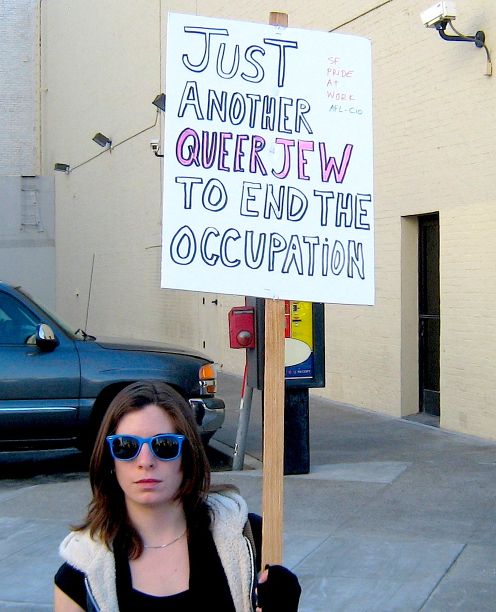
Among the signs in the Anti-Israel demonstration recently in San Francisco (where else) was the following sign:


(Photo courtesy of Zombie Time)

Now this individual seems clearly not clear of the concept, but somehow links three concepts: Queers, Jews, and Occupations.

Now, to help the individual out, I compiled a list of all openly homosexual people and organizations in Gaza, which I am happy to reprint here:


I also have a complete list of Jews in Gaza:

  • Gilad Shalit


ohhh - and just so there is no confusion, here is a list of all the "occupied" areas in the Gaza Strip:


Now, could someone please explain to me what the person in the photo is demonstrating for or against....

Tuesday, January 27, 2009

In the Inverse Universe of the BBC

As most readers are probably aware, Hamas Breached the "Ceasefire" today with an attack on a patrol that killed one soldier this morning.
The BBC's Headline:
Israel launches attacks in Gaza

Interesting style Guide - if Jews are attacked and they respond, it is clearly the Jews who are at fault for launching the attack.

No sign of bias here.

Sunday, January 25, 2009

Peace in our time

I was just forwarded an article Reprinted in the New Zealand Gisborne Herald by a self-proclaimed "Proud Self Hating Jews"

The article is full of idiotic statements by a Saxophone Player (who compares himself somewhat modestly to Jesus - who knew that Jesus could play the sax).

Anyway, he seems to have a world view based on the Protocols of the Elders of Zion, and blames most of the worlds problems on Israel and the Jews, however my favourite line in the article is the following:
"The rockets [From Hamas] are almost a peaceful message to the Israelis telling them: 'In case you don't realise it yet, you are living on my stolen land'.
I guess we have achieved peace in our time, Hamas have showered us with over 6000 peaceful messages over the past 6 years, and recently Israel sent back a few peaceful messages of their own.

See - Peace was easy to achieve, all you had to do was redefine firing rockets as "peaceful".

Right, now that we've created peace in our time, let's solve World Hunger, where did I put my copy of Orwell's 1984.

Sunday, January 18, 2009

My Peace Plan

Note: There is a follow up to this post here

I'm not a politician or a person of influence, but whenever the question of what we should be doing in Gaza and Judea/Samaria comes up, people always say "so what would you do". Here's my attempt to answer this question.

These are my own ideas, they are not represented by any political party or movement in Israel. I'm sure that there are many many issues that I haven't considered, and if you have any thoughts, suggestions, criticisms. please feel free to leave a comment or email me.

This is a very rough first draft that I wrote in a single sitting, if I get feedback or additional ideas, I may expand these ideas (and fix the spelling and grammar), or maybe not. Right now I'm trying to put down my first draft in writing to see if it looks as interesting on paper as it does in my head.

The Problem

In a nutshell, the problem is that Jews and Arabs share a tiny peace of land and have to learn to live together.

The reality is that there are no quick or simple solutions to this problem. If anyone says they have a solution for "Peace Now" or we have a "Small window of opportunity to create a new Middle East", they are probably mistaken. To solve this problem will not be quick or easy, it will take decades or generations for Jews and Arabs to break down the mistrust and hatred and learn to live together.

Currently in Israel, there is very little interaction between Jews and Arabs, and the amount of interaction over the past few years is getting less and less.

In my opinion, the solutions that have been proposed until now are part of the problem. The Oslo Accord started a process to separate the two populations, making it almost impossible for Jews and Arabs to interact.
The terrorism that followed Oslo and the counter-terrorism measures that followed lead to further alienation between the two peoples.

Similarly, solutions on the far right (such as "Transfer") are another way of increasing the problem; instead of looking at how we can get along with each other, this solution is an attempt at how we can separate or disengage from one another, this can only lead to additional hatred.

I think that we have to realize that government negotiators locked in secret discussions deciding exactly where a border should or not be drawn is not going to get us to love one another, rather it encourages extremist positions. Especially as the negotiators believe that a compromise will have to be reached somewhere between the two opinions. This encourages each party to go to the bargaining table to adopt as extremist opinion as possible so that the compromise will be closer to their actual demands. For example, if in reality a Palestinian negotiator would be prepared to accept 90% of Judea/Samaria, if that's his opening position he's unlikely to get anything close to that. Rather he should be clear that he wont accept anything less that 120% as well as a right of return and be adamant that he wont settle for less. That's the way business is done in a middle-Eastern market.

The solution


The solution is to leave the political process for now, and instead work on mutual understanding at the personal level. It will take many years to get back to the level of personal interaction that existed before the Oslo accords, and decades beyond that to reach levels of trust that would make real peace even a possibility.
However, if we really do learn to trust and live with one another, the exact nature of the political solution, whether it's an independent state, semi-autonomous regions, full annexation with citizenship of the Palestinian minority, or another solution will be immaterial.

Border disputes between the US and Canada don't lead to mistrust or hostilities, they just sit down and work out a solution. I don't really think that the Jews and Arabs will have the level of understanding the Americans and Canadians have, but we should at least be working in that direction.

A Note About Gaza


Before I go on, I should say that I think we are too late to ever create peace with Gaza. The withdrawal by Israelis in 2005 and the subsequent takeover by Hamas was the nail in the coffin of ever learning to live together.
It is possible that if in a generation or two we do have real peace with the Palestinians in Judea/Samaria, maybe the Gazans will be more open to living with us, but I fear that this is no longer possible in the next 30 years.
In the mean time, we should pursue a different solution which I don't want to go into, maybe Daniel Pipes' Egyptian solution, or a UN imposed solution, or a solution imposed by the threat of serious Israeli retaliation to any attacks - but none of these "solutions" are "Peace", they are at the most a lull in hostilities. This essay is addressing Judea and Samaria, where I believe that if we start moving in the right direction, peace is possible down the road. Maybe our children or grandchildren will live to see it.

Building Interaction


The basis of my concept is to build interaction between Jews and Arabs where they interact with each other on a personal level as equals or partners.
Right now, almost the only Arabs I see on a day-to-day basis are construction workers or menial labourers. It is almost inconceivable that I would have an Arab doctor, lawyer accountant, business partner, or close friend. It just doesn't happen to ordinary Israelis. This is the type of interaction we have to build.
There are a few organizations working in this direction, such as the "Peace Orchestra", but these organizations are a drop in the bucket.

Interaction has to be built simultaneously at a variety of levels, for example:
  • Education
  • Health Care
  • Business
I'm sure that there are other areas that could be added to this list.
These interactions would lead to more personal contact, which would lead to more trust and understanding on a personal level which would lead to the chance for us to really get along.
If a businessman in Modi'in has a business partner in Ramallah (a fifteen minute drive), there is no way that either party would want a border between the two offices. Unless of course it was an open border where they could travel freely between the two countries without fear.

Right now, any Jew going into Ramallah will almost certainly be killed, possibly lynched by an Arab mob, not exactly conducive to building a business relationship.

Education


The key to building understanding must start with education.
One of the biggest failings of the Oslo accord was that there was no attempt to enforce the clauses about education.
I was teaching in an Israeli public school when the accords were signed. The classes were all given projects where they drew "peace" showing Jews and Arabs arm and arm, drew Israeli and Palestinian flags etc.
Unfortunately, at the same time, when the PLO took over the Palestinian school system, they replaced the Israeli textbooks with old Jordanian texts which literally wiped Israel off their maps. Haifa, Acco, and Jaffa were all listed as Parts of Palestine, and Jews and Jewish history were no where to be seen.

I believe that we have to develop a curriculum for both Jewish and Arab students that includes the following:

  • Language: Arabic and Hebrew (and English) should be compulsory at a high level at all schools. Currently Israeli and Palestinian kids are literally unable to speak to each other as they often lack a common language.

  • History: Both Jews and Arabs have a long history in this land. All schools should visit and learn about King David brining the Capital to Jerusalem, Solomon building the Temple, as well as more recent Jewish History, visiting Har Herzl and Atlit, and Gush Etzion.
    At the same time, all kids (Jewish and Arab) should visit historically significant sites to the Arab community, maybe even including Arab villages that were destroyed or abandoned in 1948. This is part of our shared history, we can't ignore half of it.

  • Personal Interaction: This is by far the most difficult but I believe the most important. We need to set up sports leagues, choirs, hiking clubs, debating teams that include both Jewish and Arab participants.
  • Higher Education: This is crucial, we need to build high-level freely accessible schools for Jewish and Arab students.
    For example, right now there is a case before the Supreme court regarding land between Modi'in Alit and the a neighbouring Arab Village (Bilin). Instead of using that land to build hostilities and mistrust between the parties, why isn't the land used to build a high-tech university, and the Arabs claiming ownership compensated heavily the for their loss of land (i.e. buy it at well above the market value).
    This school would be open to and give an opportunity to both the Haredi Jews of Modi'in Alit as well as the Arabs living n the area.
    To be successful, the school would have to by of a very high standard of education, maybe some of the top academics in the World who are so outspoken on the Palestinian cause could be encouraged to come and actually work toward coexistence.
    There could also be a synergy between the needs of the Haredi and Islamic community, e.g., separation of the sexes and arrangements for time for prayer.
    I'm sure that there are donors who would be happy to have their name associated with a school that builds coexistence between Jews and Arabs. Hopefully this would allow the school to be heavily subsidized to give an opportunity to all.
    The school would have to be 100% free of violence and extremism. All students would have to have careful background checks to show that they have no affiliation with any radical groups. This would allow students to learn in an environment free of threats or fear, and encourage local Arabs to distance themselves from radical groups as it would cost them the opportunity to advance academically and financially.

Business


An outcome of the higher education schools I mentioned above could be joint Jewish-Arab business ventures.
I'm sure that we could find a venture capitalist or donor that would subsidize hi-tech startups on the condition that the management team includes both Israelis and Palestinians.
As I said above, if a business has offices in Janin as well as Kfar Saba, the last thing that employees of either office would want is a closed border between the 2 offices.

Health Care


When our baby, Amichai, was born 3 months ago, one of things that impressed me was the number of Arabic speaking male nurses in the Surgery recovery room.
This type of interaction needs to be encouraged.
Also, if we invested heavily in health care in Judea and Samaria, building world-class state of the art hospitals staffed by both Jewish and Arab doctors, and catering to both Jewish and Arab patients, it would encourage the type of mutual interaction necessary to building peace.

Military


Unfortunately today the only interaction many (most?) Jews and Arabs have with each other is through the barrel of a gun. The only Arabic phrase that many Israelis know (myself included) is "Stop, Stop or I'll shoot" - hardly a good icebreaker in a friendly game of cards.
This interaction is unfortunately necessary. Right now Israel cannot dismantle the checkpoints or disarm, that would be a suicide pact.
What we can do is try to diminish the hostilities in these interactions (as much as that is possible). For example, the check points are necessary and have saved hundreds of lives, however instead of manning the checkpoints by 20 year old recruits, why don't they sub-contract the manning of the check point to specially trained Arabic-Speaking mature Jewish Israelis who can treat the Arabs with as much respect and assistance is possible, without compromising security.
They could have electronic passes (maybe palm scan similar to at some airports), for Arabs that need to regularly cross and have the required permits.
They should increase communication -for example if there is a security alert and a check point is closed, make an electronic sign or a website with clear information available such as who is able to cross and who they should contact in case of special circumstances.
The checkpoints should also all have Arabic speaking medical professionals who are able to assess the seriousness of all emergency cases that are brought to the checkpoint.

In conclusion


As I said, Peace Now, or even peace within 10 years is not possible. However, if we introduced some of the recommendations above, or other similar ideas, I believe that within a generation we could have a population that are really interested in making peace and living together.
If Israelis are able to travel freely and securely in Ramallah, and citizens of Ramallah have equal access to Israeli universities and hospitals, exactly who rules Ramallah, whether it is Israel, the PA, the UN, or a Bi-National state would be of secondary importance.

I'm very keen to hear all the problems with my plan, and I know that there are many - please feel free to leave a comment or email me directly.

Sunday, January 11, 2009

Another Letter to the Editor


Here is a letter that I just sent to the Sunday Star Times in New Zealand in response to a photo they published of an Anti-Israel rally in Auckland.

Bli neder I'll let you know if it gets published or there is any response.
Sir,

The photo you published of the Anti Israel protest in Auckland highlights exactly the source of the problem in the Middle East.

While Israelis all over the world yearn for, pray for, and demonstrate for peace, the Palestinian supporters protest for the complete destruction of Israel, or as it is worded in the banner displayed in the photo "Free Palestine from the Zionist Occupation". Given that the Israeli occupation of Gaza ended in 2005, the only "Zionist Occupation" is what the rest of the world refers to simply as "Israel".

As soon as the Palestinians and their supporters stop their calls for the destruction of Israel, and instead join with Israelis in calls for peace and coexistence there is no limit to what can be accomplished by Jews and Arab Palestinians living side by side.

Unfortunately, if the demonstrators in the photo are typical of Palestinian supports, it is no wonder that Israel’s repeated peace offers have been unsuccessful.

Sincerely,


Michael Sedley

Hamas in Nach Yomi

I'm a bit behind in the Nach Yomi project (Ok I'm a lot behind), but I found the second passuk of Habakkuk an apt description of the Israeli policy for the past 8 years (i.e., ask Hamas nicely to stop the missiles, and if they don't stop - we should ask again).
Sometime Tfilla without action doesn't seem to be too effective....

Habakkuk 1:2
עַד-אָנָה ה' שִׁוַּעְתִּי, וְלֹא תִשְׁמָע: אֶזְעַק אֵלֶיךָ חָמָס, וְלֹא תוֹשִׁיעַ
How long, HASHEM, shall I cry, and You wont listen? I cry out unto you Hamas, and you didn't listen

The Radical left shows its immorality

One of the very few journalists to be critical of Israel's defensive action in Gaza is fellow Modi'in Resident, Larry Derfner (I still regularly ready him in the hope that one day he'll make a rational argument, it's yet to happen...).

Anyway - his latest column showed clearly the immoral position of the radical left:
"But the Hashomer Hatza'ir kibbutzniks near Gaza who've been catching Kassams wanted the operation, and they apparently convinced Jumis [the nickname of party leader Haim Oron, himself a member of a kibbutz in the South] and that was that," said Meretz member Hillel Schenker, co-editor of the Palestine-Israel Journal.

Why should the Kibbutznik's who've been catching Kassams be the ones encouraging the operation. I thought that all Jews were responsible for one another, surely the socialists of Hashomer Hatzair should know that.
If defending the South of the country is correct, it is correct irrespective of which citizens are being bombed, if it's immoral, it's immoral even if it's my house that's being targeted.
If the only ones actively supporting the operation in Gaza are the ones directly in the line of fire, it shows that the entire organization is tragically mis-guided.
Why should the leadership of Hashomer Hatzair in other parts of the country react differently just because it's someone else's kibbutz that's being bombed.

And what did the kibbutzim in the south say when the kibbutzim in the North were being bombed.

If we as a country (or Hashomer Hatzair as a movement) really care about one another, it should be those outside the line of file screaming the loudest to protect their comrades under fire.

It seems that members of Hashomer Hatzair have forgotten what it means to be part of a nation, and can't think past the gate of their own kibbutz, and that is truly a tragedy.

Wednesday, January 7, 2009

Netzarim Today


According to recent reports, Israeli tanks have reentered the former Jewish town of Netzarim.

I is important for us to remember that the current war is a direct result of the decision of the Government in Israel to throw Jews out of their homes and allow Hamas to take over and terrorize the Gaza Strip.

The song "Al kol Eleh" by Naomi Shemer was written after Israel evacuated Yamit. I always found the most powerful line to be "Don't uproot what has been planted"
Look at the before and after pictures of Netzarim, how could we have uprooted that which we had planted. (For additional pictures, see GushKatif.net)

I think that Naomi's song is more relevant today than ever...


Every bee that brings the honey
Needs a sting to be complete
And we all must learn to taste the bitter with the sweet.

Keep, oh Lord, the fire burning
Through the night and through the day
For the man who is returning
from so far away.

Chorus:
Don't uproot what has been planted
So our bounty may increase
Let our dearest wish be granted:
Bring us peace, oh bring us peace.

For the sake of all these things, Lord,
Let your mercy be complete
Bless the sting and bless the honey
Bless the bitter and the sweet.


Save the houses that we live in
The small fences and the wall
From the sudden war-like thunder
May you save them all.

Guard what little I’ve been given
Guard the hill my child might climb
Let the fruit that’s yet to ripen
Not be plucked before its time.


Chorus:

As the wind makes rustling night sounds
And a star falls in its arc
All my dreams and my desires
Form crystal shapes out of the dark.

Guard for me, oh Lord, these treasures
All my friends keep safe and strong,
Guard the stillness, guard the weeping,
And above all, guard this song.

Chorus:
For the sake of all these things...

על כל אלה
מילים ולחן: נעמי שמר

על הדבש ועל העוקץ,
על המר והמתוק,
על בתנו התינוקת
שמור אלי הטוב.

על האש המבוערת,
על המים הזכים,
על האיש השב הביתה
מן המרחקים.

על כל אלה, על כל אלה,
שמור נא לי אלי הטוב.
על הדבש ועל העוקץ,
על המר והמתוק.
אל נא תעקור נטוע,
אל תשכח את התקוה
השיבני ואשובה
אל הארץ הטובה.

שמור אלי על זה הבית,
על הגן, על החומה,
מיגון, מפחד פתע
וממלחמה.

שמור על המעט שיש לי,
על האור ועל הטף
על הפרי שלא הבשיל עוד
ושנאסף.

על כל אלה...

מרשרש אילן ברוח,
מרחוק נושר כוכב,
משאלות ליבי בחושך
נרשמות עכשיו.

אנא, שמור לי על כל אלה
ועל אהובי נפשי,
על השקט, על הבכי
ועל זה השיר.

על כל אלה..

Tuesday, January 6, 2009

MSNBC News Coverage

For the first time that I recall, a lot of foreign news coverage is at least attempting to show the realities behind the current war.

Take a look at this depiction of life in Sderot from MSNBC:


(hat tip: Gruntig!)

Sunday, January 4, 2009

Letter to the New Zealand Herald

The New Zealand Herald posted an editorial calling for the destruction of Israel as a Jewish State.

I just sent the following response, we'll see whether it gets published...
As a New Zealand citizen living in Israel, I read with horror an Editorial in the New Zealand Herald indirectly calling for my death.

The Editorial calls for the destruction of Israel as a Jewish State, saying, "Change may require something as drastic as reconsideration of Israel's need of a Jewish majority, the reason for its resistance to a full Palestinian right of return."

If the Palestinian leadership is to be believed, when Palestinians have a majority in Israel and take over leadership, they would use their power to kill or expel all the Jewish residents.

In spite of the Herald’s claim that “Judaism was freely practised in the Islamic empire”, today there is only one country in the Middle East where Jews, Christians, and Muslims are free to practice their religion without fear or persecution, and that is Israel.

For the Herald to call for the destruction of the one free country in the region and the only Jewish state in the world shows a very limited understanding of the realities in the Middle East.

Monday, December 15, 2008

Why are the Biggest Lunatics Jews

The Israeli Ministry of Foreign Affairs finally did something right - they Denied entry to Richard Falk. Who was coming as a representative of the UN Human Rights Council.

Evidently it takes a very type of stupidity to get a job for the UN Human Rights Council. Mr Falk is not only highly critical of Israel, comparing Israel to Nazi Germany, but is also a 9-11 "Troofer" and was also a supporter of Ayatollah Khomeini (may he rest in pieces).

Sounds like just the right person to work for the United Nations, after all you wouldn't want the crackpot dictators that control the UN to employ people that have even a minimal moral compass or common sense.

Among his recent quotes:
"Such a policy of collective punishment initiated by Israel to punish Gazans for political developments within the Gaza Strip constitutes a continuing flagrant and massive violation of international humanitarian law."

There you have it - what business is it of Israel to punish Gaza for internal political developments like lobbying dozens of missiles against our towns. I mean surely missiles are covered as part of free speech and for Israel to discourage it is a gross violation of human rights.

Ohh - BTW, did I mention that Mr Falk claims to be Jewish, which figures - the lunatic fringe is filled with Jews.

Sunday, November 2, 2008

At Last - Good news for politics in Israel

Today the local Israeli news is finally offering some good news, one of the very few honest politicians in this country is returning to politics and is is set to rejoin the Likud.

In recent years Israelis have had a very poor choice as the leaders of all the major parties have been particularly corrupt or unsavoury individuals.

I have always thought that the Israeli political system (maybe any political system) was designed for the worst type of individuals to rise to the top, and idealist honest individuals get pushed out.

The best examples of honest, ideological politicians in recent years were Natan Sharansky (one of my childhood heroes) and Benny Begin (who is very much like his father, also one of my childhood heroes), both of whom were unable to survive in the Israeli political system.

If the reports are true and Benny is really coming back to the Knesset, with a realistic place on the Likud list, that may well influence my vote (until now I have never voted Likud).
If they manage to bring Natan Sharansky back on board, they may have secured this vote.

My dream Government: Benny as Prime Minister, Natan Sharansky as Foreign Minister, Biby as Finance, and Effi Eitam Minister of Defence - hey, a guy can dream can't he?